How to Start Small Habits: Tiny Steps, Real Consistency
By Florian Lindner · Last updated: 4 October 2026
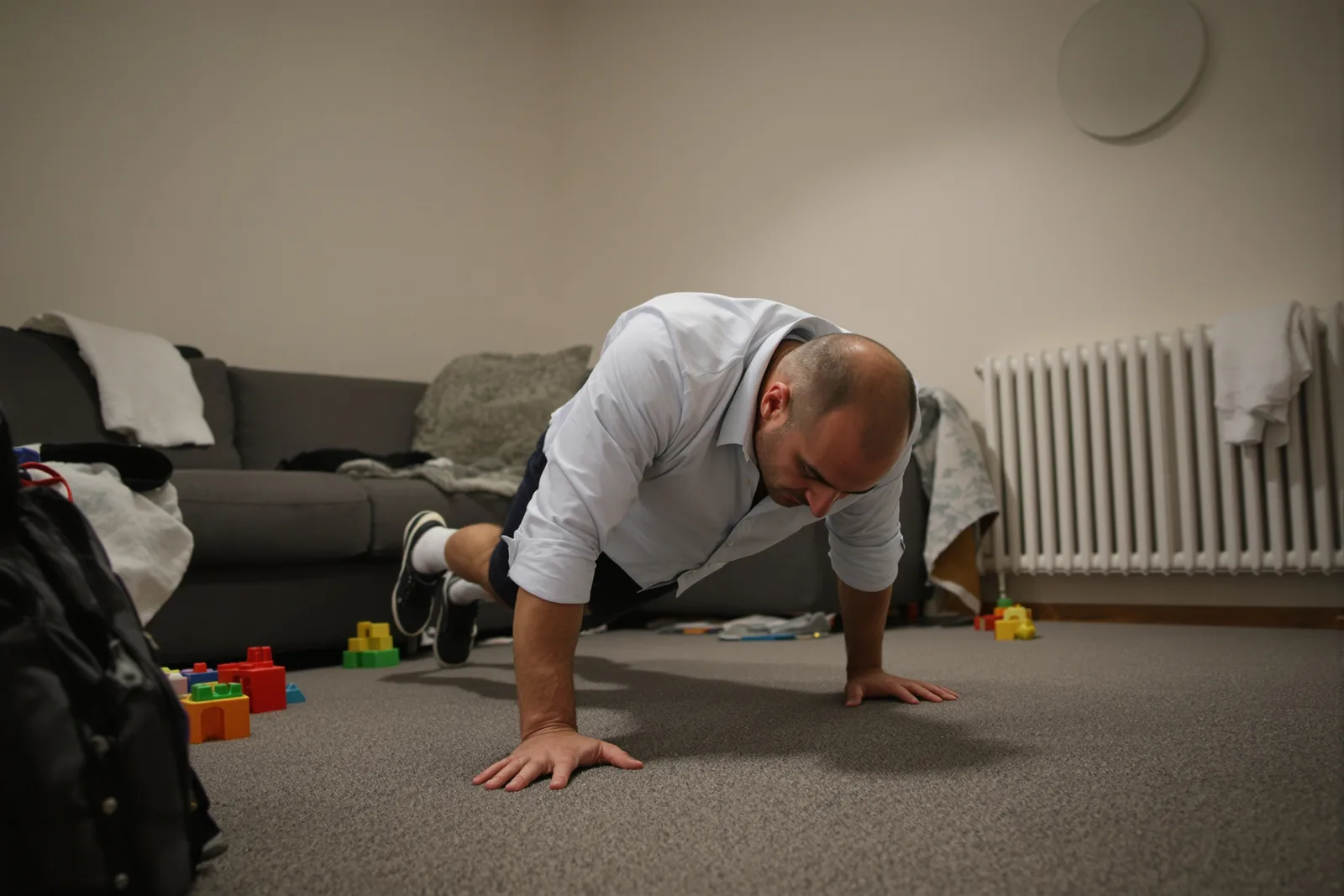
How to start small habits: shrink the behavior until failing is almost impossible. One push-up, one sentence in a journal, one minute of breathing. The bar sits lower than any excuse, so you start every day, and often you choose to do more. The key is permission to genuinely stop at the minimum, without guilt.
Why starting small is a strategy, not a compromise
A mini habit is the smallest useful version of a habit: one push-up, one written sentence, one minute of quiet. Starting small isn’t a fallback for people who lack motivation. It’s one of the most reliable ways to get moving at all, and to keep going.
Sounds too simple? That’s exactly why it works. Most plans don’t fail because of too little ambition. They fail because of too much. If you build habits by starting with an hour of exercise a day, you’ll find your first excuse by day three. By day five, the project is history.
The bar sits lower than any excuse
The part of you that bargains its way out of things is a tough negotiator. But it has no argument against a single push-up. “No time” doesn’t work for 30 seconds. “Too tired” doesn’t work for one sentence in a journal. The minimum is so small that putting it off feels absurd.
That changes the starting conditions completely. You stop waiting for motivation. You don’t need it. If getting started is hard for you in general, this is the lever: the entry bar drops below the threshold of every excuse.
Big plans feel like a lot of effort, the payoff feels far away, so you put them off. That’s why, if you want to stop procrastinating, you’re rarely fighting laziness. You’re fighting an entry bar that feels too high. And that’s the honest answer to how to stop procrastination habits: make the first step smaller than the resistance. Try it right now. Write down your plan and ask yourself what the very first physical action is. Do only that.
Consistency beats intensity
One push-up a day barely changes your body. But 365 days of showing up can noticeably change how you see yourself. Habits form through repetition in the same context, not through heroics on January 1st.
Intensity impresses. Consistency builds. That’s the difference between a good intention and an identity.
Permission to stop is the real trick
The core of the method is counterintuitive: you’re allowed to stop at the minimum. Really. No guilt, no quiet “I should really do more”.
That permission protects the habit on bad days. And on good days, something interesting happens: once you’re on the floor, you rarely do just one push-up. Starting was the work. The rest is momentum.
What the research says about small habits
Small, near-term goals can clearly strengthen motivation, persistence and self-efficacy, especially at the beginning.
A classic study here comes from Bandura and Schunk (1981). Children with serious difficulties in math worked through self-directed lessons: one group with small near-term goals, one with a single distant goal, one with no goals at all. The result was clear. The near-goal group learned faster, developed genuine interest and a stable belief in their own ability. In this study, the distant goal did practically nothing. For getting started, that means small goals often carry further than they sound.
How long it takes for repetition to turn into autopilot was studied by Lally and colleagues (2010) at University College London: on average 66 days, with a range from 18 to 254 days. Two details matter for mini habits. First, simple behaviors became automatic faster than complex ones. Second, a single missed day barely affected habit formation.
That fits with the findings of Amabile and Kramer (2011), who analyzed nearly 12,000 diary entries from working professionals. Nothing motivated people more than noticeable progress in meaningful work, even tiny progress. Small wins are fuel, not decoration.
And BJ Fogg, who developed the Tiny Habits method at the Behavior Design Lab at Stanford, describes the mechanism in his book “Tiny Habits” (2019) like this: it isn’t repetition that creates habits, it’s emotion. The good feeling right after the behavior is what wires it into the brain.
An honest caveat belongs here. Fogg’s own data come from his coaching program with tens of thousands of participants, not from independent randomized trials. The building blocks of the method are well supported. The method as a whole is less rigorously tested. You can read how we handle this kind of evidence on our science page.
How to start small habits, step by step

A mini habit takes shape in five steps: shrink, anchor, do, celebrate, make it visible. Here’s the process you can start with today. Think of it as a simple tiny habits worksheet: grab a sheet of paper and write one line for each step.
-
Shrink the behavior until it’s ridiculous. Take your target behavior and halve it until it makes you laugh. “Go for a run” becomes “put on my running shoes”. “Meditate” becomes “sit and breathe for one minute”. “Write a book” becomes “type two sentences”. This is how to make habits easy. The test: could you do it on your worst day, tired, stressed, running late? If not, go smaller.
-
Attach it to a fixed anchor. A mini habit without a trigger gets forgotten. Link it to something that already happens every day: after brushing your teeth, after your first coffee, after closing the front door behind you. This principle is called habit stacking. The existing routine becomes the starting signal for the new one.
-
Do only the minimum. One push-up. One sentence. One minute. More is allowed but never required. The minimum is the deal. Everything beyond it is a bonus.
-
Celebrate right away. Straight after you’ve done it: a quiet “yes”, a fist pump, a quick grin. It feels silly, but it works. According to Fogg, that positive feeling in the moment of the behavior is what actually wires it in.
-
Make the tick visible. A cross on the calendar, a line on a sticky note, a check mark in an app. A habit tracker turns single days into a chain, and you won’t want to break the chain.
Here’s a hypothetical example. Imagine someone who has wanted to “finally get back into exercise” for years. Three gym memberships, three times they quit. The mini habit version would be: one squat after brushing their teeth, nothing more. For the first few days it might stay at one. Over time it may become more, by choice. Not because they have to, but because their self-image slowly shifts toward someone who simply trains.
20 mini habits that actually work for body, mind and relationships
The best mini habits are concrete, take less than two minutes and fit onto an existing anchor. Here are 20 tried-and-tested starting versions. Pick one, not ten.
Body
- One push-up after getting up
- One glass of water before your first coffee
- One squat after brushing your teeth
- One deep breath before every meal
- The stairs instead of the elevator, just one floor
- 30 seconds of stretching after sitting down at your desk
- Put on your running shoes and step outside
Mind
- Write one sentence in your journal
- Meditate for one minute after your coffee
- Read one page before bed
- Note three things that went well today
- Learn one word of a new language while the kettle boils
- Unlock your phone only after breakfast
- Write down a thought instead of turning it over at night
Relationships
- Send one message to someone you’re thinking of
- Give one honest compliment a day
- When you get home, hug first, talk second
- Ask one more question before you talk about yourself
- Put your phone away when someone walks into the room
- Say a short thank you, specific rather than generic
Important: this list is a buffet, not a mandatory menu. One mini habit done every day beats twenty good intentions.
From mini to more: when and how to scale up
Your official minimum stays small, at least until the habit runs on its own, which often takes two months or more. What you do beyond that minimum can grow in tiny steps after two to four weeks of steady practice, as a voluntary extra, not as a new obligation.
The most common mistake: too much, too soon. After five good days, ten push-ups feel like the new minimum. They aren’t. Habit formation takes time, around two months on average, often longer. Raise the minimum before then and you’re building on motivation instead of autopilot. And motivation is an unreliable colleague.
Three rules for scaling up cleanly:
- Your official minimum stays small. Even if you’ve long been meditating for ten minutes, the deal is still “one minute”. That way the habit survives chaotic weeks.
- Grow your voluntary extra in tiny steps. From one push-up to three. From one sentence to one paragraph. Never double it, and never follow some training plan’s template just because it exists.
- Going back to the minimum is always allowed. A stressful phase, illness, a move? Back to one. That’s not a step backward. That’s the whole point of the system.
In the long run, something other than the numbers matters anyway: “I do one push-up” becomes “I’m someone who trains”. That shift from behavior to identity is the real win. It’s the idea behind identity-based habits.
3 common mistakes that stop small habits from sticking
Most mini habits don’t fail because of the concept. They fail because of three avoidable mistakes: quietly raised expectations, too many habits at once and no fixed trigger.
Mistake 1: The silent expectation creep. Officially, one push-up is enough. Unofficially, you’re disappointed when it was only one. That destroys the core of the method: the permission to be small. If the minimum feels like failure, it isn’t a minimum anymore. It’s a maximum goal in disguise.
Mistake 2: Five mini habits at once. Small doesn’t mean free. Every new habit needs attention until it runs on its own. Start six in parallel and you’ll have forgotten four of them by Friday. One to three, no more.
Mistake 3: No concrete trigger. “Meditate for a minute sometime today” fails because of “sometime”. Your brain needs a clear signal: when X happens, I do Y. That’s exactly what if-then plans are for. They turn a vague intention into a fixed reflex.
The mini habit principle at Hypnotic Rise
At Hypnotic Rise, the mini habit principle lives in the low bar. In the Hypnotic Rise program, you listen to your hypnosis in bed in the evening, right where you already are. Which areas you work on and how many hypnoses you receive comes out of an in-depth analysis of all 11 areas of your life in a 1:1 call. Every hypnosis is written for you alone. And if you do miss an evening, you simply carry on the next one, without guilt. Because identity isn’t built on the perfect days. It’s built on the hard ones, when you show up anyway.
Final thoughts: small isn’t a detour, small is the path
Mini habits don’t win through size. They win through presence. One push-up a day beats the perfect training plan that ends up in a drawer by week two.
Start today. Pick one behavior, shrink it until it’s ridiculous, attach it to an anchor and give yourself permission to stop at the minimum. That’s really all there is to how to start small habits. To see how it grows into a whole system, take a look at the overview on how to build habits.
But maybe you know this feeling too: you know exactly how it works. And still that inner voice shows up, calling one push-up ridiculous, or quietly asking for more after three days. Then knowledge alone isn’t enough. The pattern behind it sits deeper than any good intention.
That’s where hypnosis comes in. With the free introductory hypnosis, you choose a ready-made hypnosis on the topic that’s holding you back right now and listen to it calmly in the evening. No effort, no commitment. A first small step, very much in the spirit of mini habits. If you later want hypnoses written only for you, you can read more about the Hypnotic Rise program.
Try it yourself
Knowledge alone rarely changes anything. Listen to how your topic can feel different.


FAQ: how to start small habits
What are mini habits, and how do you start small habits?
Mini habits are habits in their smallest useful form, so small that failing is almost impossible. Instead of “30 minutes of exercise”, you do one push-up. Instead of “keeping a journal”, you write one sentence. The idea goes back to Stephen Guise and to BJ Fogg’s Tiny Habits method from Stanford. The goal isn’t the minimum itself. It’s the daily repetition that slowly turns into something automatic.
Will one push up a day do anything?
Yes, because the effect comes from consistency, not from a single rep. One push-up a day won’t make you fit. But it keeps the habit alive, and on many days you may choose to do more. Research on near-term goals also suggests that small, reachable steps strengthen self-efficacy: the belief that your actions make a difference. That belief is what carries you over the long run.
How long does it take for small habits to become automatic?
On average about 66 days, with a wide range from 18 to 254 days depending on the person and the behavior. That comes from the study by Lally and colleagues (2010). Small habits have an edge here: simple behaviors like drinking a glass of water tended to become automatic faster than more demanding ones like exercise. Still, plan in weeks, not days.
How many mini habits should I start at once to stay consistent every day?
One, or three at most. Each mini habit is tiny, but each one needs its own trigger and its own bit of attention. Start five or six at once and the effect gets diluted, and you forget half of them. A pattern that works well: start with a single mini habit, keep it steady for two weeks, and only then add a second one. Fewer projects, more progress.
What should I do if I miss a day while learning how to start small habits?
Simply carry on the next day. No catching up, no self-blame. The data from Lally and colleagues suggest that a single missed day barely slowed habit formation. A useful rule of thumb: never miss twice in a row, so the exception doesn’t turn into a new pattern. And keep your comeback deliberately small: just the minimum, nothing more.
Sources
- Lally, P., van Jaarsveld, C. H. M., Potts, H. W. W., & Wardle, J. (2010): How are habits formed: Modelling habit formation in the real world. European Journal of Social Psychology, 40(6), 998–1009.
- Bandura, A., & Schunk, D. H. (1981): Cultivating competence, self-efficacy, and intrinsic interest through proximal self-motivation. Journal of Personality and Social Psychology, 41(3), 586–598.
- Amabile, T., & Kramer, S. (2011): The Power of Small Wins. Harvard Business Review, 89(5).
- Stanford Graduate School of Business (2020): Building Habits: The Key to Lasting Behavior Change (interview with BJ Fogg). Stanford GSB Insights.
Go deeper: Building habits

Free · ready to listen · no credit card
Your free hypnosis
Pick a ready-made hypnosis on your topic. Free, no credit card.
or book a free 1:1 analysis call right away