How to Deal With Sunday Night Anxiety: Ease Into Monday
By Florian Lindner · Last updated: 4 October 2026
Learning how to deal with Sunday night anxiety starts with understanding it. Usually it is not a bad job but a hard transition: free days end abruptly, your brain rehearses the week ahead and your sleep rhythm has shifted. A Friday wrap-up, a short Sunday evening ritual and a clear first task on Monday can make the start of the week feel noticeably lighter.
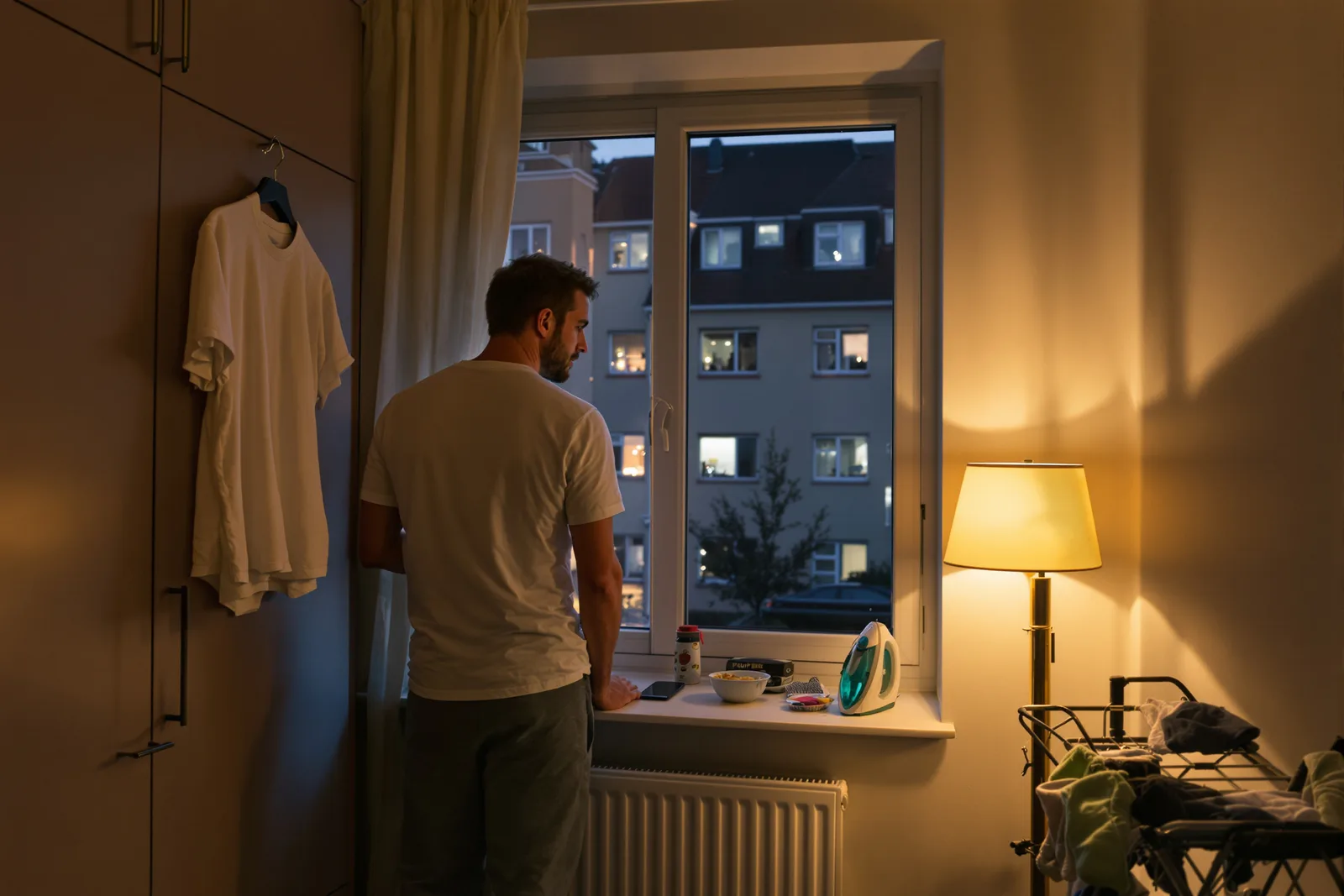
Sunday, 9 pm. The evening could be lovely, if it weren’t for that knot in your stomach. Tomorrow is Monday. And something inside you is already tightening.
If that sounds familiar, you’re not ungrateful and you’re not weak. Lots of working people know this feeling, and it can change. Usually there’s no drama behind it. Just a badly designed transition between freedom and obligation.
This article is part of our topic area on finding fulfilment at work, because how your Monday feels says a lot about how well your working life fits you.
Why do I get anxiety on Sunday night?
Monday feels heavy because three effects come together: the sudden contrast with a free weekend, your mind rehearsing the working week in advance, and a body still running on weekend time. None of these automatically means your job is wrong for you.
The contrast effect: freedom ends abruptly
At the weekend, you decide. When you get up, what you do, who you spend time with. On Monday morning, the calendar takes over. Autonomy turns into someone else’s schedule, from one minute to the next.
That switch is the hardest of the whole week. Not because Monday is objectively worse than Thursday. Because the drop is steeper. After two free days, the same working routine feels like a climb. Like stepping into cold water straight out of the sauna.
Anticipation: Monday starts on Sunday
Your brain doesn’t wait for the alarm. It runs the week in advance: the full inbox, the meeting, the task you didn’t finish on Friday. And your body reacts to that simulation as if it were a real demand. Shallow breathing, restlessness, poor sleep.
Psychologists call this anticipatory stress. It explains why the Monday blues often don’t happen on Monday at all, but on Sunday from late afternoon onwards. If that rings a bell, you might also want to read what helps when you generally can’t stop thinking about work after work.
Social jetlag: your body is still in weekend mode
Up until 1 am on Friday and Saturday, then asleep until 10? You’ve just pushed your internal clock back by hours. When your Monday alarm goes off at 6:30, it’s ringing in the middle of your biological night.
You know the result. You get out of bed on the wrong side before the day has even begun. Part of your Monday dread is simply tiredness, home-made the weekend before.
Sunday scaries and Monday blues: what the research shows
Two findings matter most. The infamous “Blue Monday” is a myth: mood on Mondays is no worse than on other workdays. What is real is the hard jump from the weekend into the working week, and you can measure it from the moment you wake up.
Stone et al. (2012) analysed telephone surveys of 340,000 people in the US. The result: people don’t feel worse on Mondays than on Tuesdays to Thursdays. What does exist is a clear weekend effect. Mood rises on Saturday and Sunday and drops again as the week begins. So Monday isn’t a particularly bad day. It’s just the day with the biggest contrast.
The stress beforehand even shows up in saliva. Schlotz et al. (2004) from the University of Trier showed that the cortisol response after waking is markedly higher on workdays than at weekends, most of all in people with a heavy workload and a habit of chronic worrying. On workdays, your body ramps up a stress system before you’ve even reached the coffee machine. The British Whitehall II cohort confirmed this pattern independently.
Then there’s sleep. The concept of social jetlag comes from the research group around chronobiologist Till Roenneberg (Wittmann et al., 2006). If you live much later at the weekend, you shift your internal clock, a bit like flying across several time zones. You can read how we work with studies at Hypnotic Rise on our science page.
How to stop the Sunday scaries: step by step

You don’t fix Sunday night anxiety on Monday. You ease it between Friday afternoon and Sunday evening, with decisions that take the weight out of Monday before it begins.
- Close the week on Friday. 15 minutes: note what’s still open, choose your first task for Monday.
- Keep your sleep times roughly steady. No more than an hour’s difference at the weekend.
- Build a Sunday evening ritual. Reflection instead of your inbox, details below. A regular wind-down routine before bed gives the ritual a frame.
- Design your Monday. No difficult meetings before 10 am, no inbox as your first move, lunch break blocked in the calendar.
- Start with Friday’s first task. How that works is explained in the Monday start section below.
- Give Monday evening a highlight. Sport, friends, the cinema: a fixed plan you look forward to.
- Observe yourself honestly for one week. Is it only Monday that feels heavy, or every day? The self-check follows in the next section.
Is it normal to dread going to work on Monday? Transition problem or job problem
The key question: does the feeling dissolve once you’re busy on Tuesday, or does the heaviness stay all week? A transition problem often eases well with rituals. A job problem doesn’t.
Try an honest self-check. First: how does Wednesday at 11 am feel? Neutral to good, or just as leaden as Sunday evening? Second: are there tasks, people or projects in your week you actually look forward to? Third: does a normal weekend restore you, or are you starting tired weeks tired?
An honest caveat belongs here. If every workday feels like Monday, it isn’t a blues. It’s a signal. Sunday rituals won’t help then, because a bigger question is on the table. Either about the job: is meaning missing from your work? Is it only fear of leaving your job for a new one that keeps you there? Or is it time to reinvent yourself professionally? Or about your health: ongoing exhaustion, cynicism and a drop in performance call for a check-up with a doctor or psychotherapist, with burnout in mind. An article can’t decide that. A professional can.
For everyone else: your Monday problem is most likely a transition problem. That’s good news, because transitions are something you can shape.
What helps Sunday scaries: a ritual to close the week and open the next
An effective Sunday evening ritual takes 15 minutes and has two parts. You consciously close the old week and open the new one. In writing, always at the same time, always in the same order.
Part 1: Close (10 minutes). Three questions, three short answers on paper. What went well this week? What’s still open? Which of those things genuinely has priority on Monday? It sounds trivial, but it does something: your mind no longer has to hold on to anything. Overthinking is often just an attempt not to forget what’s unfinished.
Part 2: Open (5 minutes). Three priorities for the week. A quick look at the first task you chose on Friday. And one thing you’re honestly looking forward to this week. After that, work thoughts have a parking ban. If one sneaks in anyway, write it down and put it aside. If your whole Sunday tends to feel wired, you’ll find helpful techniques in our guide to reducing stress and calming your nervous system.
Picture a hypothetical example. Someone checks their email “just quickly” at 10 pm on Sunday and then lies awake until 1. Now picture the same person writing in a weekly notebook for ten minutes at 8:30 pm instead, with the phone left in the kitchen. That’s the whole point: letting Monday start on Monday again. Not on Sunday at five.
How to beat the Monday blues at work: the 20-minute start
The first 20 minutes of Monday morning decide who runs the day: you or your inbox. So that time belongs to you, not to other people’s requests.
The sequence is deliberately simple. No phone for the first 20 minutes. A glass of water, two minutes of daylight or movement. Then a body anchor: upright posture, one deep breath, one deliberate gesture. A physical start signal you repeat every Monday. And then the first task you decided on in advance, phrased as an if-then plan: when I open my laptop, I’ll work on X for 20 minutes before I read any email.
Why does this work? Because you already made Monday’s hardest decision, what to start with, on Friday. Your tired Monday self only has to carry it out. To turn this start into a stable habit, have a look at our guide to a realistic morning routine before work.
Once that first task is done, Monday often feels different. Not because there’s less work. Because you’re in it as the one acting, not the one being pushed along.
The 3 most common mistakes
Mistake 1: Living the weekend as a parallel universe. If you function from Monday to Friday and do everything differently at the weekend (rhythm, sleep, pace), you build the very contrast you suffer from on Monday. The wider the gap between your two lives, the harder the landing. A good weekend restores you. It isn’t an escape plan.
Mistake 2: “Getting ahead” on Sunday. Checking email on Sunday evening feels like control, but it stretches your working week to seven days. Worse: by giving in to the Sunday anxiety, you reward it and train it to come back. Work belongs in those 15 minutes on Friday. Your Sunday ritual is reflection, not inbox.
Mistake 3: Numbing the feeling instead of reading it. A series binge, snacks, another glass of wine. Numbing drowns out the blues, but it doesn’t answer it. The feeling on Sunday evening is information about your week. If you drown it out for years, you may eventually miss the louder signals too.
Your Monday is feedback
Sunday night anxiety before work is not a verdict on you. It’s feedback about your transition, and sometimes about your job. The transition is something you can start shaping next week.
And if your honest answer is that it’s not just Monday? That’s no reason to panic. It’s the start of an important clarification. We explore what a working life that fits you can look like in our topic area on finding fulfilment at work.
Why knowing how to deal with Sunday night anxiety isn’t always enough
Maybe you know this one. You know exactly what helps: the ritual, steady sleep times, the first task. And still the knot in your stomach shows up as soon as Sunday comes around. That’s not a lack of discipline. The pattern sits deeper than your knowledge, in the image of your working week you carry without realising it.
That’s where hypnosis comes in. You don’t have to force anything. You approach the pattern in a relaxed state. If you’d like to try it, our free hypnosis lets you choose a ready-made session on the topic that’s on your mind right now and listen to it calmly in the evening. Afterwards, you can book a free 45-minute 1:1 analysis session with one of our top coaches, where all 11 areas of your life are analysed in depth. From that, a Hypnotic Rise program can be built just for you, with every hypnosis written only for you.
One important note: hypnosis is self-help. If you’re dealing with ongoing exhaustion, low mood or sleep problems, it does not replace advice from a doctor or psychotherapist.
Try it yourself
Knowledge alone rarely changes anything. Listen to how your topic can feel different.


FAQ: how to deal with sunday night anxiety
Is it normal to dread going to work on Monday?
Yes, and the research is more nuanced than the “Blue Monday” myth. An analysis of 340,000 respondents (Stone et al., 2012) found that mood on Mondays is no worse than on Tuesdays to Thursdays. What is real is the weekend effect: mood rises on Saturday and Sunday and drops as the week begins. So the dread is mostly a contrast experience. The jump from freedom to obligation feels like a fall, even though Monday itself is an ordinary workday.
How to deal with Sunday night anxiety fast: what helps the Sunday scaries most?
A short Friday wrap-up plus a 15-minute Sunday evening ritual. On Friday, note what is still open and choose your first task for Monday. On Sunday, reflect on the week in writing and set three priorities, without opening your inbox. On Monday, start with that small task before email. Keep weekend sleep within an hour of your weekday times and plan a Monday evening you look forward to. You can try all five next weekend.
Why do I get anxiety on Sunday night?
Because your brain is rehearsing the week ahead. Anticipatory stress triggers real physical reactions, even though nothing has happened yet. You can see it in the stress hormone cortisol: the response after waking is markedly higher on workdays than at weekends, especially in people with a heavy workload and a tendency to worry (Schlotz et al., 2004). Sunday night anxiety is not imagined. It is your body preparing for expected demands, which is exactly why calming rituals can help.
How to deal with Sunday night anxiety that lasts all week?
First, check whether it really does. A blues that fades once you are busy on Tuesday is a transition problem, and rituals and a better week start often help. If the heaviness stays all week, for months, it is a signal: either the job no longer fits you, or you are exhausted. Then two questions belong on the table: a job change, or a medical check-up with burnout in mind. Neither is failure. Both are self-leadership.
Does sleeping in at the weekend help with Sunday night anxiety before work?
Only up to a point, and too much can make it worse. If you stay up and sleep in much later on Friday and Saturday, your internal clock shifts back. Chronobiologists call this social jetlag (Wittmann et al., 2006). Your Monday alarm then goes off in the middle of your biological night. Better: stay within an hour of your weekday times and catch up on sleep with an earlier evening rather than a later morning.
Sources
- Stone, A. A., Schneider, S., & Harter, J. K. (2012): Day-of-week mood patterns in the United States: On the existence of “Blue Monday”, “Thank God it’s Friday” and weekend effects. The Journal of Positive Psychology, 7(4), 306–314
- Schlotz, W., Hellhammer, J., Schulz, P., & Stone, A. A. (2004): Perceived work overload and chronic worrying predict weekend–weekday differences in the cortisol awakening response. Psychosomatic Medicine, 66(2), 207–214
- Wittmann, M., Dinich, J., Merrow, M., & Roenneberg, T. (2006): Social jetlag: Misalignment of biological and social time. Chronobiology International, 23(1–2), 497–509
- Kunz-Ebrecht, S. R., Kirschbaum, C., Marmot, M., & Steptoe, A. (2004): Differences in cortisol awakening response on work days and weekends in women and men from the Whitehall II cohort. Psychoneuroendocrinology, 29(4), 516–528
Go deeper: Career fulfilment

Free · ready to listen · no credit card
Your free hypnosis
Pick a ready-made hypnosis on your topic. Free, no credit card.
or book a free 1:1 analysis call right away