How to Stop Thinking About Work After Work: 6 Rituals
By Florian Lindner · Last updated: 4 October 2026
The laptop is closed, but your mind is still at work. If you’re wondering how to stop thinking about work after work, start here: your brain doesn’t switch off because it never gets a stop signal. So you give it one. Use a fixed transition ritual between work and home, park open loops on paper, and fill your evening with active engagement instead of passive scrolling.

Why you can’t switch off from work when the day ends
Your mind keeps running because your brain has no off switch for work. It only leaves work mode when it gets a clear stop signal. And that signal is missing from your day.
The laptop closes, the phone stays on, and somewhere in between you’re supposed to recover. It just doesn’t happen. Your calendar says the day is over, but your head is still on shift. That isn’t a personal failure. It’s a mechanism. And understanding it is a big part of learning to reduce stress and calm your nervous system.
Three things keep your mind in work mode.
Your brain doesn’t know office hours
Your stress system responds to perceived demands, not to the clock. As long as your brain rates tasks as open, important or threatening, it stays activated. At 6 pm just as much as at 11 pm.
The boundary used to be physical: factory gate shuts, work is over. Today you carry the office in your pocket. Every push notification is a small signal to your system: not done yet. Stay alert.
On top of that, knowledge work has no natural end. A brick wall gets finished at some point. A strategy never does. There’s always one more email, one more idea, one more tweak. If the task doesn’t define an end, you have to. Otherwise nobody will.
Responsibility keeps your system on standby
The more depends on you, the harder it is to let go. The stressor-detachment model by Sonnentag and Fritz describes exactly this pattern: high workload makes it harder to detach mentally, just when you need it most. If you’re under a lot of pressure at work, you’re the person most likely to take it home with you.
In short: not being able to switch off isn’t a sign of weakness. Often it’s a sign that you take your job seriously. Your body just ends up paying the bill.
Rumination feels like work, but it isn’t
Going over your boss’s email for the tenth time in bed feels productive. It isn’t. Research separates two kinds of work-related thinking: problem-solving thought and affective rumination, meaning the emotional replaying of frustration, worry and what-ifs.
The first sometimes moves you forward. The second goes round in circles and wears you out. If you want to stop the mental merry-go-round, you don’t need better arguments against your thoughts. You need a different evening plan for your brain.
What the research shows
Recovery research paints a fairly clear picture here. Free time on its own doesn’t restore you. What restores you is what happens in your head during that time.
With the Recovery Experience Questionnaire, Sonnentag and Fritz (2007) identified four experiences that make up recovery: psychological detachment, relaxation, mastery experiences and control over your free time. Psychological detachment is seen as the key factor. The researchers describe it as “the feeling of being away from the work situation”, and they mean mentally, not just physically.
A study by Querstret and Cropley (2012) with 719 working adults shows what the opposite costs. Affective rumination about work predicted both acute and chronic fatigue, partly through poorer sleep. Problem-solving thought didn’t have this effect. So thinking about work isn’t what drains you. Ruminating is.
To be fair, there’s a limitation. Many of these findings come from questionnaire studies. They show strong associations, not lab-tested proof for every individual case. You can read how we at Hypnotic Rise handle research and evidence on our science page.
How to stop thinking about work after work: step by step
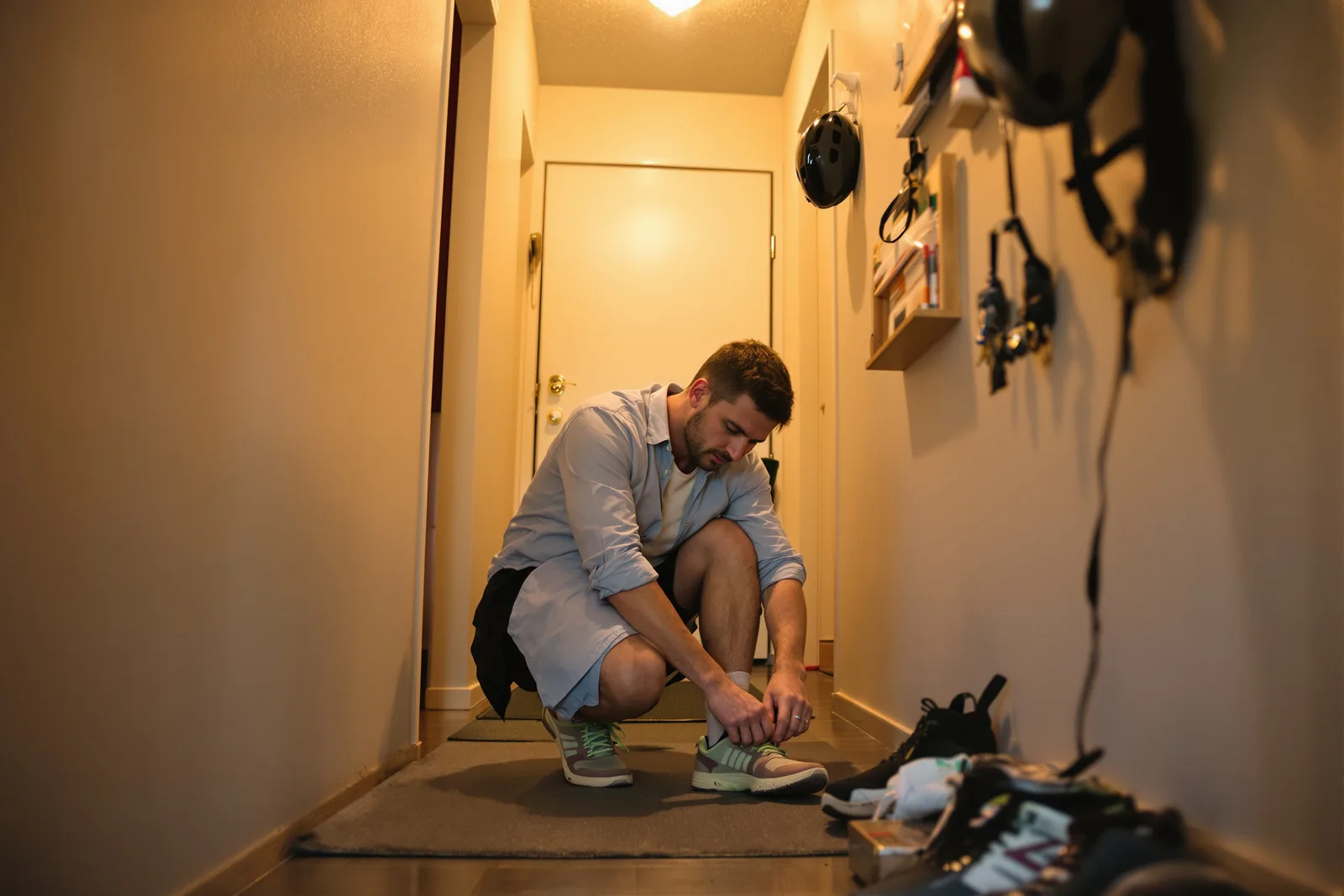
You don’t learn to switch off through willpower. You learn it through a system of fixed signals. Here’s how to build one:
-
Set a real end point. Not “when I’m done”, but a fixed time, ideally as an if-then plan: if my alarm goes off at 6:15 pm, then I shut down my computer.
-
Park open loops on paper. Before your end point, write down everything unfinished along with the next concrete step, for example “Client proposal: check figures at 9 am tomorrow”.
-
Mark the boundary physically. Changing clothes, a walk round the block or a fixed body anchor, like three deep breaths with your hand on your chest, tells your system: shift’s over. You’ll find steps 1 to 3 laid out as a 10-minute routine further down.
-
Give your evening a job. An empty evening is an open invitation for work thoughts. Plan an active block: cooking, exercise, a call with a friend. Anything that challenges you a little keeps your mind busy.
-
Keep an emergency reset ready. If work pops back into your head anyway, you need something quick. Short relaxation techniques of under five minutes, like a longer exhale, bring you back without wrecking your evening.
-
Repeat it for 14 days before you judge it. One attempt proves nothing. Rituals work through repetition, not intensity. And if you’re wondering how long it takes to wind down after work: it varies from person to person, and for many people it gets shorter the more often they repeat the same routine.
If a baseline physical tension still lingers, it’s worth looking into how to ease inner restlessness. That’s often the second issue hiding behind not being able to switch off.
Why your brain won’t let go of unfinished tasks: the Zeigarnik effect
Your brain treats unfinished tasks like open browser tabs. They stay active, use up resources and keep pushing themselves to the front. This is called the Zeigarnik effect: unfinished things stay more present in your mind than finished ones.
Here’s what matters for your evening: you don’t have to finish the tasks to get peace. In a series of experiments, Masicampo and Baumeister (2011) showed that unfulfilled goals create intrusive thoughts and even worsen performance on other tasks. But once participants made a concrete plan for the open goal, those effects disappeared, even though nothing had been done yet.
For you, that means the five-minute list at the end of the workday isn’t a tidiness habit. It’s the stop signal your brain has been waiting for. Task plus next step plus time, and the tab can close.
Your after work wind down routine: the 10 minutes between work and evening
A transition ritual is a fixed sequence of actions between your last work task and the first moment of your evening. It replaces the factory gate that working from home took away.
Here’s what it can look like, split across ten minutes:
- Minutes 1–4: Wrap-up. Write down open tasks, set a next step for each, glance at tomorrow’s calendar. Anything with a plan counts as done for today.
- Minutes 5–6: Full stop. Shut down your computer. Actually shut it down, don’t just close the lid. Work phone on silent and out of sight.
- Minutes 7–10: Transition. Change clothes, wash your face or walk round the block. Add your body anchor: the same gesture, every day.
A hypothetical example: picture a team lead working from home whose office is three metres from the dining table and whose evening exists only on paper. A ritual that could suit her: at 5:45 pm, write a three-line list, shut down the computer and walk round the block, whatever the weather. The walk becomes her commute.
Which actions you pick doesn’t matter much. What matters is that they’re the same every day. Your brain learns patterns, not intentions. Over time the switch often happens almost by itself, the same way you don’t negotiate with yourself about brushing your teeth in the morning.
Active vs passive recovery: why scrolling doesn’t help you switch off
Scrolling feels like a break, but it doesn’t restore you. It distracts you without really occupying your mind. Between two videos there’s plenty of room for a thought about Monday’s presentation.
Recovery research explains why. Two of the four recovery experiences described by Sonnentag and Fritz are mastery and control: activities that challenge you a little, and the sense that you’re shaping your own evening. Passive consumption offers neither. It parks you, but it doesn’t refill anything. After two hours of feed you’re rarely more rested than before. Just later.
Active recovery doesn’t mean competitive sport. Cooking without a recipe video running alongside. A conversation where your phone stays in your bag. Twenty minutes of swimming, an instrument, building a shelf. Mental techniques count too: when you learn self-hypnosis, you give your attention a clear task instead of hoping background noise will do the job.
The rule of thumb: recovery is whatever holds your attention and belongs to you. Not whatever costs the least energy.
The 3 most common mistakes
Mistake 1: You try to force relaxation. “Just relax already” is a work order, and it only makes the tension more noticeable. Recovery follows from the right conditions: an end point, a ritual, active engagement. Build the conditions, not the pressure.
Mistake 2: You check your email “just quickly”. A glance at 9 pm doesn’t cost you two minutes. It costs you the rest of the evening. Every contact with work reopens the loops you parked at 6. The if-then plan against it: if I want to reach for my work phone in the evening, then I drink a glass of water first and decide again afterwards.
Mistake 3: You treat your evenings as repair work for a job that leaves you empty. If your work keeps grinding you down or feels pointless, even the best evening ritual can only soften the impact, not solve it. Then it’s worth looking at the bigger question: what would it take to find fulfilment at work for you?
One note that belongs here: everything in this article, hypnosis included, is self-help for everyday tension. If sleep problems or exhaustion last for weeks, it doesn’t replace seeing a doctor or psychotherapist.
Switching off starts with your identity
The six steps help many people find distance in the evening more easily. But you probably know this feeling: you’ve known for ages what you should do in the evening, and you still don’t do it. That isn’t a lack of discipline. The pattern runs deeper than any list. It sits in the picture you have of yourself. If you define yourself by always being available, you’ll eventually override every ritual.
This is where knowledge alone isn’t enough. Hypnosis works on the level where patterns like this live. The simplest way to try it is with a hypnosis on exactly this topic: pick a ready-made hypnosis for switching off in the free introductory hypnosis and listen to it in bed tonight.
If you want to go deeper after that, one of our top coaches will analyse all 11 areas of your life with you in a free 45-minute 1:1 analysis session. That can lead to a programme built only for you: Hypnotic Rise, with every hypnosis written just for you.
Try it yourself
Knowledge alone rarely changes anything. Listen to how your topic can feel different.


FAQ: how to stop thinking about work after work
Why can’t I switch off from work even when I’m tired?
Tiredness and tension run on two different systems. Your body is exhausted, but your stress system keeps going as long as your brain flags tasks as unfinished. The Zeigarnik effect keeps incomplete work active in your mind. In experiments by Masicampo and Baumeister (2011), making a concrete plan for open goals clearly reduced intrusive thoughts, even though the tasks weren’t done. Being tired isn’t enough. Your mind needs a stop signal.
What is the fastest way to stop thinking about work after work?
Write down every open task and add the next concrete step for each one. It takes five minutes and takes away your brain’s reason to keep working on it. Then change rooms or change clothes to mark the boundary physically. For acute tension, short breathing techniques with a longer exhale can help. This doesn’t replace a lasting ritual, but it can give you some distance tonight.
Is it normal for managers to struggle to detach from work emotionally?
It’s common, but not harmless. The more responsibility and workload you carry, the harder it gets to detach mentally. That is exactly what the stressor-detachment model by Sonnentag and Fritz (2015) describes. But common doesn’t mean without consequences. Ongoing rumination about work is linked to poorer sleep and chronic fatigue. Take it seriously before your body forces you to. Detaching is a skill you can learn, even with a full calendar.
Why doesn’t scrolling or TV help me stop thinking about work after work?
Because passive consumption distracts you without restoring you. While you scroll, your mind stays free enough to jump back to work between posts. Recovery research by Sonnentag and Fritz (2007) shows that recovery needs mental distance and, ideally, activities that challenge you a little: sport, cooking, an instrument, a real conversation. Active engagement occupies your working memory. Passive input leaves the back door open for work thoughts.
When should I get help if I can’t stop thinking about work at night?
If sleep problems, exhaustion or irritability last longer than a few weeks or noticeably limit your daily life, talk to your doctor or a psychotherapist. Persistent rumination can be part of depression or an anxiety disorder, and evening rituals won’t resolve that. The techniques in this article help with everyday tension. They are training, not treatment. The two don’t exclude each other, but neither replaces the other.
Sources
- Sonnentag & Fritz (2007): The Recovery Experience Questionnaire. Journal of Occupational Health Psychology
- Querstret & Cropley (2012): Exploring the Relationship Between Work-Related Rumination, Sleep Quality, and Work-Related Fatigue. Journal of Occupational Health Psychology
- Sonnentag & Fritz (2015): Recovery from Job Stress: The Stressor-Detachment Model as an Integrative Framework. Journal of Organizational Behavior
- Masicampo & Baumeister (2011): Consider It Done! Plan Making Can Eliminate the Cognitive Effects of Unfulfilled Goals. Journal of Personality and Social Psychology
Go deeper: Stress relief
Where it shows up in life

Free · ready to listen · no credit card
Your free hypnosis
Pick a ready-made hypnosis on your topic. Free, no credit card.
or book a free 1:1 analysis call right away