How Does Hypnosis Work Scientifically: What Studies Show
By Florian Lindner · Last updated: 4 October 2026
How does hypnosis work scientifically? It is a natural state of focused attention with a lowered critical filter, measurable in EEG and fMRI studies. You stay awake and keep control over your actions. What makes it work is your own ability to focus your attention, and you can practice using it.

Most people have no idea what hypnosis actually is. They know the swinging pocket watch, the stage show, the cliché of the helpless volunteer. Most of that is wrong. Hypnosis is a natural state you brush past every day: just before you fall asleep, lost in a film, zoned out on a long drive.
This article clears things up. No mystical fog, no promises of miracles. Just what neuroimaging and psychology actually show. And a clear path for using that knowledge yourself, as the foundation for learning how to do self-hypnosis.
Is hypnosis real or fake? Where the confusion comes from
Most misconceptions about hypnosis don’t come from research. They come from entertainment. Stage shows, films and advertising have shaped a picture that has almost nothing to do with what happens in the lab.
Three sources feed the confusion more than any others.
The show shaped the picture
Whatever you think you know about hypnosis probably comes from the stage, where people cluck like chickens on command, forget their own name or start dancing. We explain further down why the stage is so misleading. You’ll find more misconceptions in our piece on common hypnosis myths.
The word sounds like sleep
“Hypnos” was the Greek god of sleep. The name sends you in the wrong direction. The state itself has very little in common with sleep.
Under hypnosis, you are awake. Your attention is actually sharper, just tightly focused. The term is a historical accident. It simply describes the state incorrectly.
Giving up control feels scary
Many people worry they’ll lose control in trance. That fear is understandable, but mostly unfounded. According to current research, you stay responsive in trance and can reject suggestions that don’t sit right with you.
You can end the trance on your own at any time: the way you close a book.
Is hypnosis scientifically proven? What the research shows
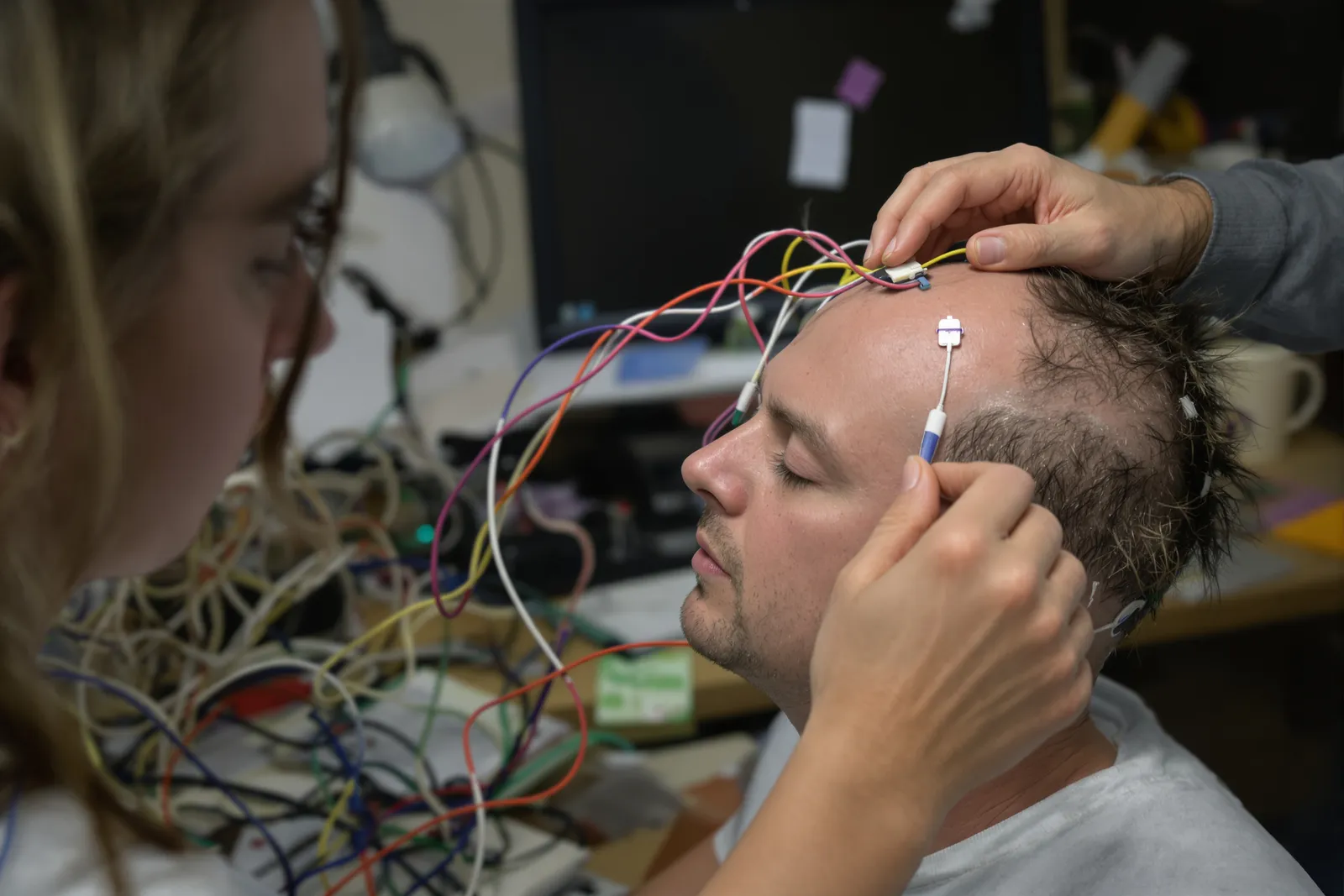
Hypnosis is not imagination. It is a measurable brain state. Imaging methods show clear changes during trance in exactly the networks that steer attention and self-awareness.
The Stanford study by Jiang and Spiegel (2017) is central here. The team screened 545 people and scanned 57 of them with fMRI: those with very high and very low responsiveness. Under hypnosis, activity dropped in a region that evaluates what matters right now (the dorsal anterior cingulate cortex). At the same time, the connection weakened between the prefrontal control center and the default mode network, which is linked to rumination and self-reference. The connection between the prefrontal control center and the insula, which processes body signals, grew stronger. Put simply: the inner commentary steps back, and your connection to bodily experience gets closer.
So how does hypnosis work on the brain? The brain doesn’t switch off. Its networks reorganize. The attention system holds the focus while the self-commentary fades into the background. This pattern has little in common with sleep: you stay awake, and your attention system stays active. If you want to use this in practice, the step-by-step self-hypnosis guide shows you how.
The second pillar is the review by Oakley and Halligan (2013) in Nature Reviews Neuroscience. Their conclusion: hypnosis uses the power of attention and suggestion to change experience and behavior. They classify responsiveness as a stable, normally distributed trait. Not a personality flaw. Not weak will.
So what is hypnosis in psychology, by the field’s own definition? The official version from the APA division, written by Elkins and colleagues (2015), reads roughly like this: a state of consciousness involving focused attention and reduced peripheral awareness, characterized by an enhanced capacity for response to suggestion. It hardly gets more sober than that.
An honest limitation belongs here too. Not everyone responds the same way. A small share of people are low responders. They only reach a light trance. That is normal and nothing to worry about. Even with average responsiveness, you can experience trance well and practice it. If you want to know what studies look at regarding hypnosis and anxiety, there is an overview in hypnotherapy for anxiety: what the research says. Important: hypnosis is self-help and does not replace medical or psychotherapeutic treatment.
Are you awake during hypnosis? How a trance unfolds, step by step
A trance doesn’t hit you all at once. It unfolds in stages. Your brain doesn’t switch off, it redirects its attention. Here is the typical sequence.
-
Your focus narrows. You direct your attention to one point: the voice, your breath, an image. Everything else moves into the background. Your attention system now works narrowly instead of broadly.
-
Your body relaxes. Muscles loosen, your breathing slows. This isn’t the trance itself, but it paves the way. Many people feel a pleasant heaviness here.
-
The inner chatter quiets down. This is exactly where the Jiang and Spiegel finding comes in. The connection between the prefrontal control center and the default mode network weakens. The constant commentary about yourself goes silent for a moment.
-
Imagery gets more vivid. Mental images feel more real. Think about biting into a lemon, and your mouth might pucker. Your brain treats vivid images almost like real experience.
-
Suggestions land more easily. The critical filter that normally checks everything right away is turned down. New statements about yourself meet less resistance. That is exactly what self-hypnosis uses on purpose.
-
You come back. A few deep breaths and you’re fully here again, usually more alert and calmer than before. What exactly happens in that middle phase is covered in depth in our article on the trance state and what it feels like.
Hypnosis vs. sleep, meditation and flow
Hypnosis is related to meditation and flow, but it isn’t the same thing. And it has nothing to do with sleep. The difference lies in where your attention is pointed.
Sleep means: consciousness gone, perception off. Under hypnosis you are awake and responsive. Compare the two on an EEG and you see clearly different patterns.
Meditation often trains you to let thoughts come and go without judging them. Open awareness, broad attention. Hypnosis does the opposite: it narrows the focus and works deliberately with suggestions. Both calm the rumination network, just by different routes.
Flow is something you know from sport or work: completely absorbed in an activity, losing track of time. Here, too, self-consciousness steps back. The difference: flow comes from doing, while hypnosis is brought about deliberately and used for a goal.
Picture someone who slips into flow while running and forgets the time. In the evening, the same person spends ten minutes on self-hypnosis to rehearse a new statement about themselves. Two related states, two different purposes.
Can hypnosis control your mind? Why stage hypnosis gets it wrong
Stage hypnosis doesn’t show how hypnosis works. It shows a performance. Almost everything about it is built for effect, not for the real process.
The first trick is selection. The hypnotist tests the audience and picks out the most responsive people. Whoever ends up on stage belongs to the small group of highly responsive people and wants to play along.
The second factor is social pressure. In front of a hundred people, hardly anyone backs out. The expectation of now being “hypnotized” carries the behavior. That is a real psychological effect, but it comes from the situation, not from losing control.
The damage is considerable. Afterwards, people believe hypnosis means being controlled by someone else, and they shy away from the serious, useful kind. Yet it’s pure staging. What suggestions can realistically do in genuine trance is laid out soberly and with evidence in our article on how long post-hypnotic suggestions last.
The 3 most common mistakes in understanding hypnosis
Most misunderstandings come down to three thinking errors. Once you know them, you see hypnosis more clearly straight away.
Mistake 1: Tying trance to a special feeling. “I didn’t feel anything special, so it wasn’t real trance.” Not true. Trance isn’t defined by a particular feeling but by focused attention. You stay clear and present, and that’s exactly how it should be.
Mistake 2: Waiting for a big moment. Many people expect something dramatic and feel let down when it doesn’t come. Trance usually feels unspectacular: pleasant, calm, slightly absorbed. That’s exactly right. The effect builds through repetition, not through one big moment.
Mistake 3: Mistaking responsiveness for character. If you find it hard to go into trance, you might quickly decide you’re “too controlled” or “too rational.” Nonsense. Responsiveness is a fairly stable trait and says nothing about you as a person. What you can practice is how you work with trance: getting into it faster, holding your focus. That also helps you use the basic technique in everyday life, for example to reduce stress and calm your nervous system.
How Hypnotic Rise puts the science of hypnosis to work

At Hypnotic Rise, hypnosis isn’t an end in itself. It’s a tool for how you see yourself. We use exactly that quieter inner commentary and that heightened responsiveness on purpose. In a free 1:1 analysis session with one of our top coaches, we take an in-depth look at all 11 areas of your life with you. From that, we build Hypnotic Rise, a program made only for you: for your challenges, your goals, your needs. Every hypnosis in it is written only for you, and you listen to it in bed in the evening. Not as an esoteric ritual, but as repeated training based on what research knows about hypnosis. You’ll find the background gathered in one place on our science page.
The bottom line: experience it for yourself
Hypnosis is not magic and not a loss of control. It is a natural, measurable state of focused attention: backed by neuroimaging, defined by the professional field, and part of your everyday experience. You stay awake, you stay yourself, you stay in control.
The best part: you already know this ability from daily life, and you can practice working with it.
Knowledge alone doesn’t change anything, though. You can understand exactly why your mind keeps racing at night, and it still keeps racing. The pattern sits deeper than arguments can reach. That’s where hypnosis comes in: in a state of focused attention where new statements about yourself meet less resistance.
If you want to experience this rather than just read about it, start with a free hypnosis. You choose a ready-made hypnosis on the topic that’s on your mind right now and listen to it in peace. That way you find out for yourself what trance feels like for you: try a free hypnosis session on your topic. And if you later want something built entirely around you, you can learn more about the Hypnotic Rise program.
Note: hypnosis is a self-help method and does not replace medical or psychotherapeutic treatment.
Try it yourself
Knowledge alone rarely changes anything. Listen to how your topic can feel different.
 FreeChoose your free hypnosis.Every hypnosis is ready to listen and free. Choose the topic that is on your mind most right now.Choose a free hypnosis→
FAQ: how does hypnosis work scientifically
How does hypnosis work scientifically, explained simply?
In psychology, hypnosis is described as a natural state of focused attention in which your critical filter quiets down. You are not unconscious and you are not asleep. You are awake, concentrated and more open to inner images and suggestions. Think of the moment you get lost in a good book and the world around you fades, only brought about on purpose and used for a goal.
How does hypnosis work scientifically on the brain?
Brain imaging shows hypnosis is a measurable state of consciousness with altered activity. fMRI research by Jiang and Spiegel (2017) found reduced activity in the dorsal anterior cingulate cortex and weaker coupling between the prefrontal control center and the default mode network. The official APA definition by Elkins and colleagues (2015) calls it focused attention with enhanced responsiveness to suggestion. Not magic. Neurobiology.
Can hypnosis control your mind?
No. Hypnosis is not sleep, not unconsciousness and not mind control. According to current research, you stay responsive in trance, keep control over your actions and can reject suggestions that don’t sit right with you. So yes, you are awake during hypnosis. Stage hypnosis is misleading: what looks like loss of control there is a mix of preselection, group pressure and expectation, not what happens in real trance.
Can everyone be hypnotized?
Responsiveness to hypnosis follows a normal distribution: a small group responds very strongly, the large middle moderately, and a small group barely at all. It is a stable trait, not a sign of willpower or intelligence. Even with average responsiveness, you can experience trance well and practice self-hypnosis. So is hypnosis real or fake? Real. It simply varies from person to person.
Is self-hypnosis safe?
For healthy people, self-hypnosis is considered safe. You stay conscious the whole time and can end it whenever you like. Caution is needed with severe mental health conditions such as psychosis or the acute aftermath of trauma. That work belongs with qualified professionals. If you are unsure, talk to a doctor or psychotherapist first. As a relaxation and training method, the approach is well researched.
Sources
- Jiang, H., White, M. P., Greicius, M. D., Waelde, L. C. & Spiegel, D. (2017): Brain Activity and Functional Connectivity Associated with Hypnosis. Cerebral Cortex
- Elkins, G. R., Barabasz, A. F., Council, J. R. & Spiegel, D. (2015): Advancing Research and Practice. The Revised APA Division 30 Definition of Hypnosis. American Journal of Clinical Hypnosis
- Oakley, D. A. & Halligan, P. W. (2013): Hypnotic Suggestion. Opportunities for Cognitive Neuroscience. Nature Reviews Neuroscience
Go deeper: Self-hypnosis
Free · ready to listen · no credit card
Your free hypnosis
Pick a ready-made hypnosis on your topic. Free, no credit card.
or book a free 1:1 analysis call right away