How Effective Is Hypnotherapy for Anxiety: The Research
By Florian Lindner · Last updated: 4 October 2026
How effective is hypnotherapy for anxiety? Meta-analyses show that guided clinical hypnosis can measurably reduce anxiety symptoms in studies, for example around medical procedures and as an add-on to cognitive behavioral therapy. It does not replace professional treatment for anxiety disorders. For everyday nerves, self-hypnosis lets you practice a calm state that can help in tense moments.
Why hypnosis can work on anxiety
Hypnosis targets your nervous system’s automatic reactions more than your logical thinking. That’s why it can sometimes help where good arguments get you nowhere.
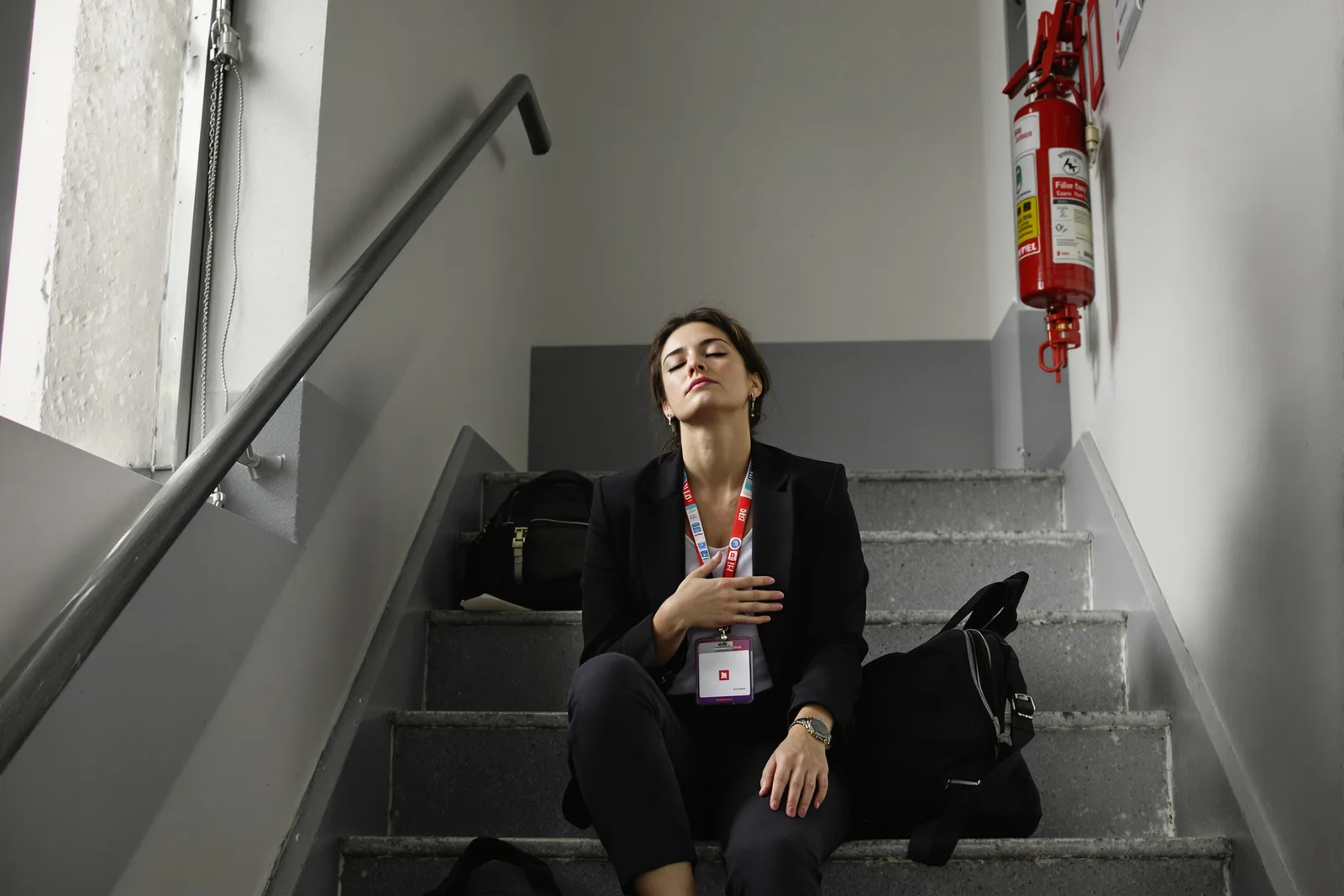
You probably know the feeling. You know the presentation isn’t the end of the world. And still: pounding heart, lump in your throat, worst-case movies playing in your head. Your mind gets it. Your body doesn’t. Self-hypnosis tries to work at exactly that level.
Important before we get to the studies: clinical anxiety, meaning panic attacks, generalized anxiety disorder or the effects of trauma, belongs in professional hands. Self-hypnosis is personal development, not therapy. It can complement psychotherapy. It never replaces it.
Anxiety is a learned alarm program
At some point your brain learned: this situation is dangerous. Since then the alarm fires automatically, faster than you can consciously think. That isn’t weakness. It’s a protective system that has become overcautious.
And what was learned can be relearned. Just not by ordering it from the top down, but through new experiences on the same level.
Trance opens access to automatic reactions
In trance, your critical filter becomes more permeable and your imagination more vivid. What happens in this state is well researched: focused attention, altered brain activity, greater responsiveness to suggestion. Not sleep, not losing control. More like a state of concentrated relaxation.
In this state you can practice linking the situation you fear with calm: you live through it in your imagination, but paired with calm instead of panic.
The calm state becomes something you can call up
The real lever: repetition can make the calm state easier to access. If you practice going into relaxation every day, over time you often find your way in faster, even in a meeting, even in a waiting room. What hypnosis actually is, and what it isn’t, is covered in our introductory article. Here the question is: what do the studies show?
Hypnotherapy and anxiety research: is it evidence based?
The short answer: in meta-analyses, guided hypnosis shows clear effects on anxiety symptoms. There are four papers worth knowing if you want to judge the evidence. The central one comes from Valentine, Milling and colleagues in 2019.
Valentine et al. 2019, the core source. Writing in the International Journal of Clinical and Experimental Hypnosis, the team analyzed 15 studies with 17 comparisons, filtered from 399 screened papers. The result: a mean weighted effect size of d = 0.79 directly after treatment. In plain terms, the average person who received hypnosis reduced their anxiety more than about 79 percent of the control group. At follow-up the effect was d = 0.99. Fewer comparisons were available for follow-up, though. So the effect at least held up in those follow-ups, but because of the smaller number of comparisons, that figure should be read with caution. One more finding: hypnosis combined with other psychological methods worked better than hypnosis alone. Overall, the authors rate hypnosis as an effective intervention for anxiety.
For context: in psychology, d = 0.8 counts as a large effect. Effect sizes from different studies can only be compared to a limited extent, though.
Three more papers fill in the picture:
- Kirsch et al. 1995, the classic. Kirsch, Montgomery and Sapirstein analyzed 18 studies from various fields, including anxiety. Cognitive behavioral therapy plus hypnosis did better on average than CBT alone: the average person with hypnosis added improved more than at least 70 percent of the comparison group. The paper was later criticized on methodological grounds, which is why the re-examination matters.
- Ramondo et al. 2021, the re-examination. This updated meta-analysis found smaller effects than Kirsch, but still an advantage for the combination, one that tended to grow at follow-up. So the added benefit of combining the two showed up in more recent data as well, if smaller.
- Tefikow et al. 2013, the special case of medical procedures. Tefikow and colleagues analyzed 34 randomized controlled trials with 2,597 patients undergoing surgery and medical procedures. In these studies, hypnosis reduced emotional distress (g = 0.53). The hypnosis was guided by professionals in a medical setting.
The pattern: depending on the paper, effects range from small to large. In two of them (Valentine 2019, Ramondo 2021), they tended to be larger at follow-up. The benefit was clearest in combination with other methods. Not a miracle cure, but a tool that research takes seriously.
How Hypnotic Rise handles studies in general, and why we care more about effect sizes than individual stories, is explained on our science page.
Honesty is part of this: the evidence has limits. Many individual studies are small, the protocols vary, and most papers looked at guided hypnosis, not pure self-hypnosis. The direction is encouraging. It isn’t a free pass.
Self-hypnosis for anxiety: step by step

Here’s how to use self-hypnosis in everyday life: first you build a stable calm state, then you deliberately link it to the situation that makes you anxious. Six steps.
- Get clear on what you’re dealing with. Everyday anxiety or an anxiety disorder? If your anxiety restricts your life, triggers panic attacks or has dominated your thinking for months: get a professional assessment first, everything else after.
- Learn the basic technique. Induction, deepening, coming back: you’ll find the tools in our step-by-step guide to self-hypnosis. Practice without any anxiety topic at first, just the state itself. The full roadmap for the basics is in our hub on how to do self-hypnosis.
- For the first one to two weeks, train only the calm state, 10 to 15 minutes a day. Regular practice makes the state easier to reach reliably. A fixed time, say right after you get up, helps you stick with it.
- Then replace your daily session with the calm protocol (12 minutes). It combines three simple elements from self-hypnosis practice: a practiced calm state, a body anchor and one concrete suggestion. The anchor is a fixed gesture, such as pressing your thumb and index finger together. With a few weeks of practice, the gesture can help you call up the state. How post-hypnotic suggestions like this work is explained in detail in a separate article.
- Sit upright, close your eyes, take three long exhales.
- Go into trance with your induction, for example a countdown from 10 to 1, one step deeper with each number.
- Picture your anxiety situation, but from a safe distance: as if on a small screen, far away.
- See yourself acting calmly. Upright, breathing, clear. Notice the feeling that goes with it.
- Press your thumb and index finger together and say your sentence silently, for example: “I stay calm and able to act.”
- Count back from 1 to 5, open your eyes, stretch.
- Set an if-then plan for the real moment (30 seconds). If the anxiety comes, then I press my thumb and index finger together, breathe out twice as long as I breathe in and say my sentence silently. Write it down in advance in exactly this if-then form. The more specific the trigger, the more reliably the plan kicks in.
- Test small, then bigger. Start with the harmless version of your anxiety situation, then build up. Small wins are what the new pattern feeds on.
Imagine a team lead whose knees regularly go weak before board presentations. A plan could look like this: a few weeks of the daily protocol, an anchor at the fingertips, one single sentence. A realistic goal wouldn’t be for the anxiety to vanish, but for her to start speaking despite the pounding heart. That’s the honest goal: not freedom from anxiety, but the ability to act.
Does hypnosis help anxiety disorders? When self-hypnosis fits and when to get help
Self-hypnosis makes sense for everyday anxiety that isn’t clinical. And it’s the wrong first choice for anything that noticeably limits your life. This line isn’t a formality. It decides whether you’re helping yourself or losing valuable time.
Self-hypnosis is worth trying for:
- Exam and presentation anxiety, stage fright
- Nerves before conversations, job interviews, confrontations
- Nervousness before medical procedures (there is a separate meta-analysis on guided hypnosis in this area, Tefikow et al. 2013; the data on pure self-hypnosis is thinner)
- Inner restlessness, tension and looping thoughts, often closely tied to chronic stress
- Fear of being judged, which is often fueled by self-doubt
Get professional help if:
- you experience panic attacks, meaning sudden waves of fear with a racing heart, shortness of breath, fear of dying
- the anxiety has been there almost every day for more than six months
- you increasingly avoid situations, places or people
- your sleep, work or relationships are noticeably suffering
- the anxiety is tied to distressing memories or depressive phases
In these cases, psychotherapy is the right path. Cognitive behavioral therapy is considered the standard for anxiety disorders. Whether and how other methods are added is something you decide together with your therapist. Getting help isn’t failure. It’s the decision a strong self-image makes. Hypnosis is a form of self-help and does not replace therapy or medical advice.
The 3 most common mistakes
Three mistakes slow people down in practice more than any others. Here they are, and what to do instead.
Mistake 1: Only practicing in an emergency. If you only reach for self-hypnosis in the middle of panic, you’re asking an untrained muscle for peak performance. The calm state has to be built in calm moments, hundreds of times, until it holds. Only then does it carry you under pressure. In our experience, short daily sessions are easier to keep up than one long session a week.
Mistake 2: Wrong expectations. If you expect miracles after three days, you’ll quit in week two. Expect weeks of practice, not quick wonders. Some of these expectations come from stage hypnosis and the movies. We clear up which ideas are simply wrong in our article on hypnosis myths.
Mistake 3: Fighting the anxiety instead of training the state. If you battle the anxiety in trance (it has to go, right now), you often intensify exactly the tension you want to get rid of. The detour works better: build calm, anchor calm, take calm into the situation. The anxiety is allowed to be there. It just doesn’t get to take the wheel.
From anxiety tool to a new self-image
Maybe you feel the way many people do after an article like this: you understand why your alarm goes off. Understanding alone is rarely enough. The pattern sits deeper than your knowledge about it, and that’s exactly where hypnosis aims to work. Behind everyday anxiety like stage fright there can be a self-image that doesn’t trust itself much.
One important point for context: the studies above examined guided hypnosis in clinical or therapeutic settings, not our hypnosis sessions. They show that hypnosis is taken seriously as a method, not that a particular hypnosis will work for you.
If you’d like to experience what this feels like, you can try our free hypnosis for a topic of your choice. You pick a ready-made hypnosis, for example on nerves before presentations, and listen to it at home in peace. Afterwards, you can book a free 45-minute analysis session with one of our top coaches to find out whether a personal program is right for you. In this 1:1 call, all 11 areas of your life are analyzed in depth. From that, Hypnotic Rise becomes a program built only for you: for your challenges, your goals, your needs, with every hypnosis written only for you and listened to in bed at night.
Please keep in mind: this is self-help for everyday nervousness and does not replace therapy. An anxiety disorder belongs in the hands of a doctor or psychotherapist.
Try it yourself
Knowledge alone rarely changes anything. Listen to how your topic can feel different.
 FreeChoose your free hypnosis.Every hypnosis is ready to listen and free. Choose the topic that is on your mind most right now.Choose a free hypnosis→
FAQ: how effective is hypnotherapy for anxiety
How effective is hypnotherapy for anxiety according to research?
In studies, guided hypnosis shows clear effects on anxiety symptoms. The meta-analysis by Valentine and colleagues (2019) pooled 17 comparisons from 15 studies and found a mean effect size of d = 0.79: the average person receiving hypnosis reduced their anxiety more than about 79 percent of the control group. At follow-up the effect was 0.99. Most studies were small and used professionally guided hypnosis, so this says little about your individual case.
How effective is hypnotherapy for anxiety compared with psychotherapy alone?
Hypnosis is not a substitute for therapy. Clinical anxiety, such as panic disorder, generalized anxiety disorder or severe phobias, belongs in professional hands. Meta-analyses across several fields, including anxiety (Kirsch et al. 1995; Ramondo et al. 2021), found that cognitive behavioral therapy plus hypnosis did better on average than CBT alone. In those studies, trained professionals used clinical hypnosis as an add-on to therapy, not a replacement. Self-hypnosis is personal development, not therapy.
How long does self hypnosis for anxiety take to make a difference?
Think in weeks, not a single session. In the studies, interventions usually ran over several sessions plus independent practice. With each repetition, the calm state can become easier to access. There is no promise of a specific timeframe, and how quickly things shift varies from person to person. Short daily practice tends to be easier to keep up than occasional long sessions.
What is the difference between hypnotherapy and self-hypnosis for anxiety?
The state is the same. Only who guides it changes. In hypnotherapy, a trained person leads you into trance. In self-hypnosis you do it yourself, using learned techniques or an audio guide. For everyday anxiety like stage fright or looping thoughts, self-hypnosis is practical: you don’t depend on appointments and can practice daily. In our experience, that regularity is what makes the state easier to reach reliably.
Can hypnosis help anxiety and depression, or anxiety and panic attacks?
Self-hypnosis makes sense for everyday anxiety that isn’t clinical: exam and presentation nerves, nervousness before conversations or dental appointments (as long as it doesn’t stop you going), restlessness and rumination. Here you train a calm state you can call up. It is not enough for panic attacks, generalized anxiety disorder, depression, the effects of trauma, or anxiety that noticeably limits your life. Then psychotherapy is the right step, and anything else you discuss with your therapist.
Sources
- Valentine, K. E., Milling, L. S. et al. (2019): The Efficacy of Hypnosis as a Treatment for Anxiety: A Meta-Analysis. International Journal of Clinical and Experimental Hypnosis
- Kirsch, I., Montgomery, G. & Sapirstein, G. (1995): Hypnosis as an Adjunct to Cognitive-Behavioral Psychotherapy: A Meta-Analysis. Journal of Consulting and Clinical Psychology
- Ramondo, N. et al. (2021): Clinical Hypnosis as an Adjunct to Cognitive Behavior Therapy: An Updated Meta-Analysis. International Journal of Clinical and Experimental Hypnosis
- Tefikow, S. et al. (2013): Efficacy of Hypnosis in Adults Undergoing Surgery or Medical Procedures: A Meta-Analysis of Randomized Controlled Trials. Clinical Psychology Review
Go deeper: Self-hypnosis
Free · ready to listen · no credit card
Your free hypnosis
Pick a ready-made hypnosis on your topic. Free, no credit card.
or book a free 1:1 analysis call right away