Does Listening to Hypnosis While Sleeping Work? The Facts
By Florian Lindner · Last updated: 4 October 2026
Does listening to hypnosis while sleeping work? Hypnosis audio works best while you are relaxed but still listening. There is little solid evidence that you absorb suggestions once you are deeply asleep, so drifting off at the end is fine, but the awake part counts. One study found suggestions heard before a nap deepened sleep in people who respond well to hypnosis. Most studies use regular listening over several weeks, ideally at a fixed time and with headphones.
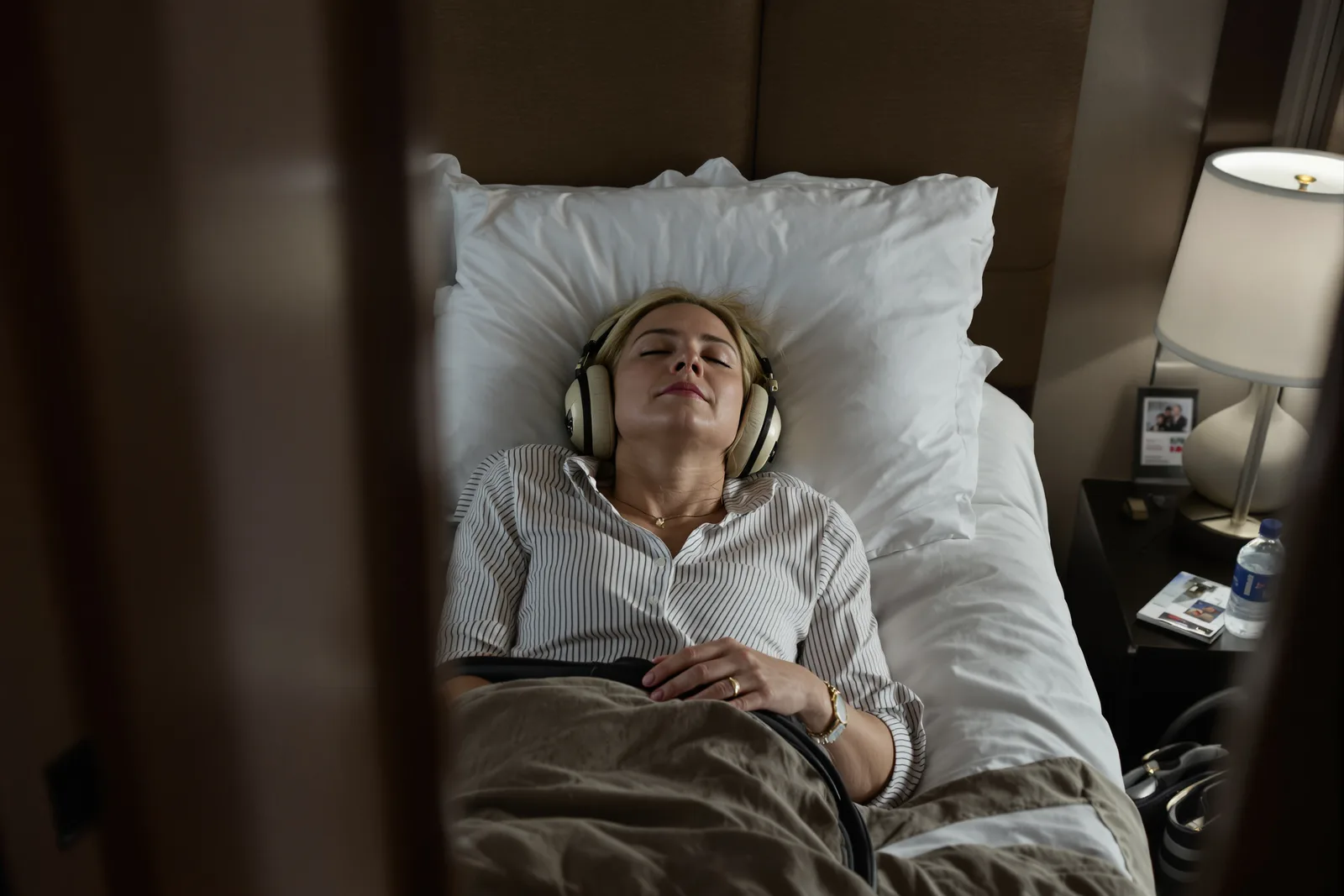
Hypnosis audio does the work for you. You don’t need to know how to put yourself into trance, because a voice guides you there. That sounds easy, and that’s the point. The hardest part of learning self-hypnosis isn’t the technique. It’s sticking with it.
This is where audio helps. It lowers the barrier to almost nothing. Headphones on, press play, listen. No script. No wondering whether you’re doing it right.
So does listening to hypnosis while sleeping work? Partly. Audio works best while you’re relaxed but still listening. But it isn’t a magic trick. It works when you listen regularly, stay with it and give it time. Here’s what it can do and what it can’t.
Why hypnosis audio works, and when it doesn’t
Hypnosis audio works because it reliably delivers two things: guidance and repetition. The voice takes the lead. You just follow. That makes the state easier to reach than with self-hypnosis on your own.
Still, the recording alone doesn’t decide the outcome. How you use it does.
The voice takes the lead
In classic self-hypnosis you play two roles at once. You’re the one relaxing and the one giving the instructions. That takes practice.
With audio, one role disappears. The voice counts you down, directs your attention and gives the suggestions. Your only job: listen and go along. For beginners, that’s a huge advantage.
Then there’s repetition. A recording takes seconds to start, every single day. That makes it easy to keep going and to make trance a regular part of your day.
Can you fall asleep while you listen? If you use a hypnosis recording for sleep, drifting off towards the end is part of the plan. Just know that the part you hear while you’re relaxed and still following is the part that counts. What about the part after you’ve fallen asleep? Research on taking in spoken suggestions during deep sleep is thin. Assume the minutes before you drift off do the work, and don’t rely on looping audio all night. If your goal is something other than sleep, try to stay with the voice until the end.
The limits are real
Now the caveat. An off-the-shelf recording is impersonal. It doesn’t know your topic, doesn’t respond to you and doesn’t go as deep as a conversation can. With deep-rooted issues or clinical diagnoses, it reaches its limits.
Important: hypnosis audio is self-help and does not replace medical or psychotherapeutic treatment. If you have ongoing sleep problems, anxiety or physical symptoms, please get them checked by a professional.
Also, not everyone responds equally well. Some people reach a deep trance easily. Others need weeks. That’s normal, and it isn’t your fault. And if you think hypnosis means losing control, you’re mistaken. More on that in hypnosis myths.
Do hypnosis recordings actually work? What the research shows
Recorded hypnosis has been studied more than many people think. Several controlled studies show measurable effects, especially on sleep and stress.
Take sleep. In Cordi, Schlarb and Rasch (2014), 70 women listened once to a 13-minute hypnosis recording before a midday nap, and in another session to a neutral text. Among the participants who respond well to suggestions, the amount of slow-wave sleep rose by 81 percent (measured by EEG) and time awake went down. Among those who responded less, there was no effect.
So the big number applies to only some of the participants.
Then there’s the question everyone asks: can audio keep up with personal guidance? Rutten and colleagues (2017) tested this in a strictly medical setting. Children with functional abdominal pain, under medical care, practiced either at home with audio or in individual sessions. Both formats performed comparably. This was medically supervised therapy, not a self-help offer, and it doesn’t transfer to other goals. But the study does show that recorded hypnosis is a format worth taking seriously.
If you want to dig deeper into the evidence, you’ll find more on our science page.
How to use hypnosis audio for sleep and beyond: step by step
Hypnosis audio only works when the conditions are right. The technique is simple. The discipline is the real work. Here’s the order that works.
-
Set a goal. Not “feel better somehow”, but something concrete: fall asleep more calmly, stay composed in meetings. If your goal is “switch off in the evening”, for example, look for a recording made for exactly that.
-
Protect ten minutes. Phone on airplane mode, door closed. Ten undisturbed minutes, no multitasking. That’s half the battle.
-
Put on headphones. They block out your surroundings and bring the voice closer. The difference compared with your phone speaker is bigger than you’d think.
-
Get comfortable but stay awake. Sitting or lying down, but not so cozy that you nod off straight away.
-
Let go and follow. No judging, no “is it happening yet?”. When thoughts come up, gently return to the voice. That’s the whole trick.
-
Repeat daily. Put it in your day like brushing your teeth. Attach it to your after-work coffee, for example, and you’ll forget it less often.
How to recognize a good hypnosis recording
A good hypnosis recording guides you in cleanly, works with clear suggestions and brings you fully back at the end. It doesn’t need big promises, and it doesn’t pressure you.
Start with the voice. It should be calm and pleasant to you. Not artificial, not rushed. Your gut reaction in the first two minutes is a surprisingly good filter. If it feels wrong, keep looking.
Then the structure. A solid recording has a clear shape: introduction, deepening, suggestions, return. The return at the end matters. It brings you back awake and oriented. Recordings made for falling asleep are the exception: they can let you drift off instead.
Three things should make you skeptical. Cure claims (“heals your anxiety in 7 days”). Suggestions that don’t match your goal. And providers who push you. Serious work is quiet. New to the topic? Start with the basics of what hypnosis is and what it can do.
The best time to listen to hypnosis and how to build a routine
The best time to listen to hypnosis is the time you can reliably manage: daily, linked to the same anchor. A fixed time beats a perfect time.
For calming down and stress relief, the evening works well. The day is done, you’re winding down anyway, and it’s easier to let the voice lead. An afternoon slot can work just as well, as long as you show up for it. If stress is your topic, our guide on how to reduce stress can help too.
For focus and a clear start, the morning fits. Some people listen right after waking up, before the day rushes in. And if falling asleep is the goal, bed is the right place.
The real lever is the anchor. Attach the recording to a habit you already have. After brushing your teeth. After your first coffee. Before lights out. That way you don’t have to decide again every day. The habit carries you.
How long before hypnosis works? Why weeks of repetition matter
With hypnosis audio, repetition isn’t an extra. It’s how it works. Single sessions can have short-term effects, as the nap study shows. But when you want a pattern in your daily life to change, most studies rely on repetition over weeks.
Think of learning an instrument. Nobody plays the piano after one lesson. When you’re learning, regularity often helps more than one long session. That’s why ten minutes on many days usually makes more sense than an hour on Sunday.
Research also backs this up in terms of practicality. In a self-hypnosis study on sleep (2023), participants practiced with the recording on around 18 of 21 days on average (about 86 percent). The reason is simple: the daily effort is small. Small hurdles are easy to keep clearing.
Research on stress relies on repetition too. In a study by Olendzki, Elkins and colleagues (2020), stressed participants combined weekly sessions with daily audio practice at home for eight weeks. Their perceived stress went down.
Many studies run over several weeks. So give yourself time before you judge. Some people notice something after a week, others take longer, and some barely respond.
3 mistakes that make hypnosis audio less effective
Most people don’t fail because of the recording. They fail because of three avoidable mistakes. Avoid them and you give the recording a fair chance.
Mistake one: listening in the background. You play the recording while checking email or doing the dishes. Then it stays background noise. Trance needs your attention. Ten focused minutes beat thirty half-hearted ones.
Mistake two: giving up too soon. Three days without a noticeable effect and you stop. But three days is too short to judge anything. Plan for at least two or three weeks.
Mistake three: constantly switching. One recording today, another tomorrow. That way no suggestion gets the repetition it needs. Choose one program and stick with it. You’ll find more common pitfalls in self-hypnosis mistakes.
One safety note: never listen to hypnosis audio while driving or operating machinery. You’re entering a relaxed, inward-focused state. That belongs somewhere safe, not in traffic.
How Hypnotic Rise uses audio hypnosis
At Hypnotic Rise, hypnosis audio isn’t an add-on. It’s the backbone. In a free 1:1 analysis session with one of our top coaches, we take a deep look at all 11 areas of your life. From that, we build Hypnotic Rise, a program made only for you. Every hypnosis is written only for you, and you listen to it in the evening in bed. How often and in what order depends on your personal program. You don’t have to search for what to listen to. You just press play. You can see how it works in detail on the program page.
Conclusion: your next step with hypnosis audio
Hypnosis audio is an easy way in. It takes over the steering and makes repetition simple. Research shows early effects on sleep and stress, especially in people who respond well to hypnosis. That’s not a guarantee.
You now know what matters: a clear goal, headphones, repetition. But knowing rarely changes much on its own. Whether you switch off in the evening or stay calm in a meeting comes down to a pattern that runs deeper than any good intention.
That’s where hypnosis comes in. Want to feel what that’s like? Pick a ready-made hypnosis on your topic in our free introductory hypnosis and listen to it tonight. Headphones on, eyes closed, just listen. Afterwards, if you want to go further, you can book a free 45-minute analysis session with one of our top coaches. That’s where a program written only for you begins.
Try it yourself
Knowledge alone rarely changes anything. Listen to how your topic can feel different.
 FreeChoose your free hypnosis.Every hypnosis is ready to listen and free. Choose the topic that is on your mind most right now.Choose a free hypnosis→
FAQ: does listening to hypnosis while sleeping work
Does listening to hypnosis while sleeping work?
Hypnosis audio can guide you into relaxation and deliver targeted suggestions without you steering anything. If you drift off towards the end, that is fine, especially when you listen to fall asleep. There is little solid evidence that you take in new suggestions once you are deeply asleep. Early studies show effects on sleep and stress, mainly in people who respond well to hypnosis. Change in daily life usually comes from regular listening over weeks.
How often should you listen to hypnosis recordings?
Regularly, ideally every day and at the same time. Hypnosis audio works like training: not through one session but through the sum of them. In one sleep study, participants practiced with the recording on around 18 of 21 days on average. The effort is small, which makes it easier to stick with. Many studies run over several weeks, so give it a few weeks before you take stock.
Does audio hypnosis work as well as personal guidance?
Audio gives you structure and makes repetition easy. Personal guidance can respond to you directly. One study with children with functional abdominal pain found that home-based audio exercises under medical supervision did not perform worse than individual sessions. That does not simply transfer to other goals. Hypnosis audio is self-help and does not replace medical or psychotherapeutic treatment.
How do you spot a good hypnosis recording for sleep?
Look for a clear structure, a calm voice and suggestions that fit your goal. A good recording guides you in cleanly and either brings you back out or lets you drift into sleep if that is its purpose. It promises no miracles and does not push you. Be wary of cure claims, constant advertising or voices that make you tense. Your gut reaction to the voice is a good filter.
Can you use hypnosis audio the wrong way?
For most healthy adults, hypnosis audio is unproblematic. If you have a mental health condition or epilepsy, talk to your doctor first. More often, people simply miss out on the effect: listening while checking email, giving up after three days, or constantly switching recordings. Use headphones, plan a fixed ten minutes and stick with one program. Never listen while driving.
Sources
- Cordi, Schlarb & Rasch (2014): Deepening Sleep by Hypnotic Suggestion. Sleep 37(6):1143–1152
- Rutten et al. (2017): Home-Based Hypnotherapy Self-exercises vs Individual Hypnotherapy. JAMA Pediatrics 171(5):470–477
- Olendzki, Elkins et al. (2020): Mindful Hypnotherapy to Reduce Stress. Int. J. Clin. Exp. Hypnosis 68(2):151–166
- Feasibility of a Self-Administered Hypnosis Intervention for Improving Sleep in College Students (2023). PMC10646898
Go deeper: Self-hypnosis
Free · ready to listen · no credit card
Your free hypnosis
Pick a ready-made hypnosis on your topic. Free, no credit card.
or book a free 1:1 analysis call right away